Grace Without Claim
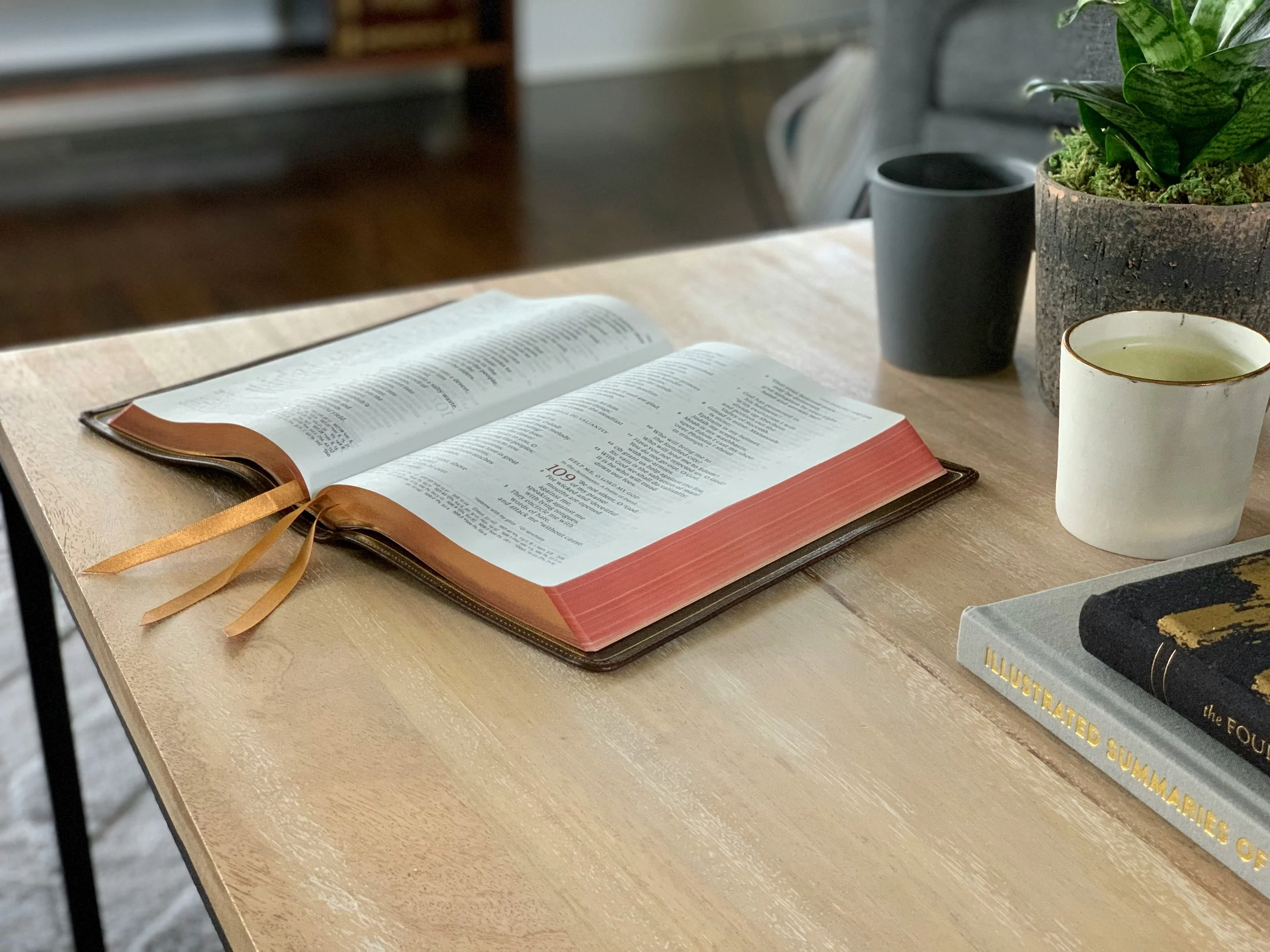
I try to stay a week ahead in sermon writing. It keeps me from preaching out of whatever happened to me on Saturday afternoon, and it gives the text time to breathe before I have to say something about it in public.
This week I was working on my Proper 5A sermon — that's June 7 on my calendar — and decided to do a wider review of my preaching calendar for the rest of the year. It turned into an unexpected education.
I discovered that the Revised Common Lectionary, which I have used for most of my ministry, contains two separate tracks for the Old Testament readings during Ordinary Time. Track 1 is semi-continuous — the Old Testament reads on its own narrative arc, largely independent of the Gospel. Track 2 is complementary — the Old Testament readings are chosen to thematically illuminate and support the Gospel reading for that Sunday.
I didn't know Track 2 existed.
Thirty-two years of fairly consistent lectionary preaching, and I had no idea there was a second table set. As it turns out, this isn't a gap in my attention. The United Methodist worship planning resources I relied on for most of my ministry published only the semi-continuous track — a deliberate denominational choice rooted in both theological preference and the practical reality of page counts. Track 2 was there all along in the full Revised Common Lectionary. I just never had it in front of me.
The discovery actually started a few weeks ago in a conversation with Father Rufus, rector of the Episcopal Church of the Epiphany. We were comparing notes on the Trinity Sunday readings, and he mentioned an Old Testament text that I simply didn't have. We were working from the same lectionary family and arriving at different tables. That conversation planted a seed. When I went back to look, I found the fuller picture — and it changed the shape of my Proper 5 preparation entirely.
Because on Track 2, the Old Testament and Gospel texts for Proper 5A are in genuine conversation with one another. And that conversation pressed me toward a harder sermon than the one I was originally inclined to preach.
The Gospel reading is Matthew 9:9–13, 18–26. It is a passage dense with perspective. Matthew the tax collector — a sinner by profession and public reputation — responds to a two-word call and leaves everything. Jesus eats at his house, surrounded by people the religious establishment had written off. Then, on the way to raise a dead girl, a woman who had been hemorrhaging for twelve years reaches through the crowd to touch the hem of his robe. She is ritually unclean. The girl Jairus is desperate to save will be unclean to touch by the time they arrive. Jesus goes anyway, to both of them.
The comfortable sermon is already writing itself: Jesus welcomes the excluded. The margins are where the Kingdom shows up. Grace has no waiting room.
All of that is true. And I know how important grace is. I have preached it for three decades because I believe it — not as a theological abstraction but as the hinge on which everything turns.
But then I got to the noisy crowd at Jairus's house.
These were professional mourners — people whose livelihood depended on public grief. When Jesus said the girl was only sleeping, they laughed at him. Not skeptical laughter, the kind that contains a question. Dismissive laughter. The laughter of people who had already decided.
And I felt the text turn toward me.
Because I had been retreating to the comfortable observation — Jesus welcomes all — in part because it's true, but also in part because it is safe. It doesn't cost me anything. I can preach God's grace with great confidence. What I am slower to examine is my own. Whether I have become, in my own way, part of the noisy crowd. Present in the room, fluent in the vocabulary, but privately certain I already know how this ends.
Dietrich Bonhoeffer called it cheap grace — grace as doctrine, as principle, as the general proposition that God forgives. Grace that makes no demand, changes nothing, and costs no one anything. He contrasted it with costly grace: the grace that calls us to follow, that transforms the one who receives it, that makes a claim on the life it enters.
That is where I landed, somewhere between the hemorrhaging woman reaching through the crowd and the mourners laughing in the back.
Grace without claim is grace without weight.
It is easy to affirm grace in the abstract — to believe in it theologically, even to preach it well — while remaining largely untouched by what it requires. The woman in the crowd risked public humiliation and ritual violation to reach for healing. Something was at stake for her. The noisy crowd risked nothing, because they had already written off the possibility that anything real was happening.
The text was asking me which one I was.
I don't usually share how the sausage gets made. Sermon preparation is interior work — part prayer, part argument, part waiting — and most of it should stay in the study. But this felt worth naming, because I suspect I am not alone in it.
It is easier to preach grace than to practice it. It is easier to believe in a God who welcomes the unclean and raises the dead than to ask whether I am still laughing in the back of the room, protecting my certainty against the possibility of being surprised.
The woman was healed. The girl got up. The noisy crowd was put outside.
And Matthew — the tax collector who became an apostle — got up from his table and followed.
Grace makes a claim. That is what makes it grace.
The full sermon manuscript from Matthew 9 will be posted following the June 7 service.