Rivers Will Flow
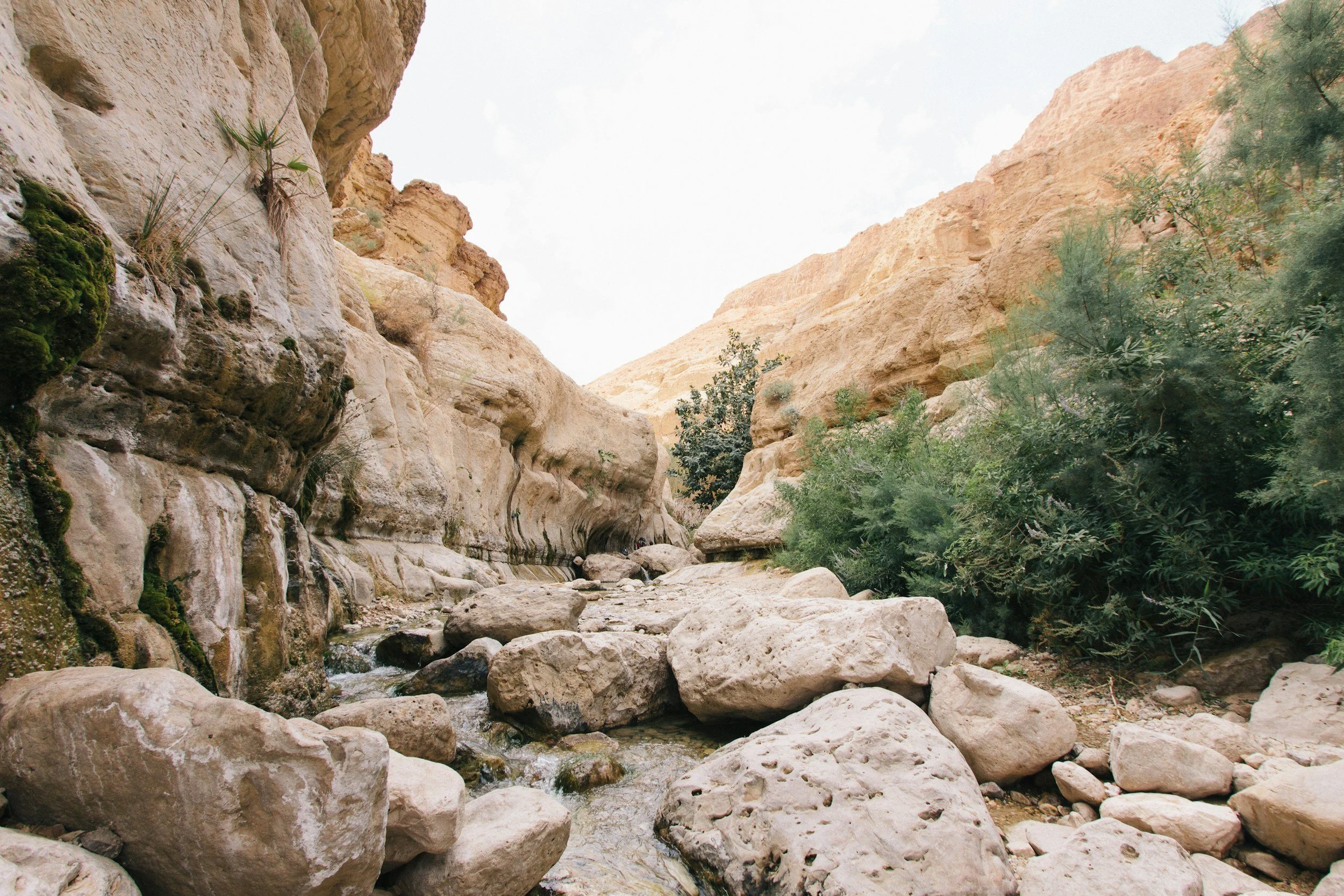
Ein Gedi, Judean Desert
What Jesus said on the last day of the festival — and why it changes what Pentecost means.
Jerusalem. The Feast of Tabernacles. The Hebrew name is Sukkot — temporary shelters. For seven days every autumn, the Jewish people built small booths and lived in them, remembering the forty years of wilderness wandering when Israel had no permanent home and depended on God for every meal, every drop of water, every breath of protection.
It was also the harvest festival. The year's last in-gathering at the end of the dry months. And it was the beginning of the rainy season, so the prayer for rain was woven through every day of the week.
There was one ritual unique to this festival. Every morning, the priests processed from the Pool of Siloam to the Temple, carrying golden pitchers of water, and poured them out at the base of the altar. For a week, the priests poured water. The whole liturgy was a kind of weeping toward heaven — send the rain, feed your people, remember us as you have always remembered us.
On the seventh day, the great day — what the rabbis called Hoshana Rabbah — the procession reached its climax. The water was poured. The crowd was loud. The festival's longest week stood at its highest point.
And a man stood up in the middle of it.
Teachers sat to teach. They gathered students around them and spoke from the bench. Standing was the posture of a prophet, or a herald, or a man with something he could not contain.
He stood, and he cried out in a loud voice.
"Let anyone who is thirsty come to me and drink. Whoever believes in me, as Scripture has said, rivers of living water will flow from within them."
Three sentences. That is the whole text. But inside those three sentences is the heart of what Pentecost means.
Begin with the invitation. If anyone is thirsty. That is where it starts — with admission. Not with belief. Not with obedience. Not with understanding. With thirst. The first step is the willingness to say: I am dry. The Sukkot crowd understood physical thirst because they lived close to the dirt. But Jesus is not only talking about water. There is a thirst the body knows and a thirst the soul knows, and the soul's thirst is harder to notice. It hides behind activity. It hides behind religion. It hides behind a busy life.
I know this in my own body. The medication I take for diabetes suppresses my appetite — and it suppresses my thirst with it. A few months ago, my voice began to fail. The doctors asked a very simple question: are you drinking enough water? I was not. The signal the body usually sends had quieted. And the thing I use to preach the gospel had begun to dry up.
Spiritual thirst can do the same thing. You can be a long-time Christian and not notice that your soul has gone quiet. You can fill your week with so much that you do not feel the dryness underneath. And Jesus, on the last day of the festival, against all the noise of poured-out water, names a thirst we have learned to ignore.
Then the invitation expands. Come and drink. Two verbs. To come is to move toward. To drink is to receive. You cannot earn it. You stand in the place of need and you receive what is given.
And here the promise turns. Jesus does not stop at drink. He says that the one who drinks becomes a source. The water does not pool in the believer. It flows out. Rivers. Plural. Not a cup. Not a swallow. Rivers.
The grammar of the promise points outward, not inward. The Spirit is not drawn into the believer to settle there. The Spirit moves through, and out. The river does not terminate in the one who drinks.
A river that does not flow is not a river anymore.
This is the heart of Pentecost.
In Genesis 11, humanity tries to make a name for itself by reaching upward. The tower goes up. The languages are scattered. People are separated from each other by the very speech that should have connected them. Babel is the story of a humanity confused, fractured, isolated.
Dr. Bill Mallard, my advisor and favorite professor at Emory, called Pentecost the reversal of Babel. The wind that came in Acts 2. The tongues of fire. The people from every nation hearing their own language — the scattering reversed, the separations crossed, the river flowing out of the Spirit-filled disciples across every boundary Babel had built.
The Spirit cannot be contained because the Spirit is by nature communicative. To have the Spirit is to be unable to hoard the Spirit. The manifestation of the gift is the sharing of the gift.
This is what Jesus was promising on the seventh day of the festival. The promise was given there. The fulfillment came at Pentecost. The river that began at the cross flows out through every believer it touches.
You do not drink so that you can keep what you have received. You drink so that you can become a place the river flows through.
And once you have drunk — let it flow.