The Day Pastors Become Heretics
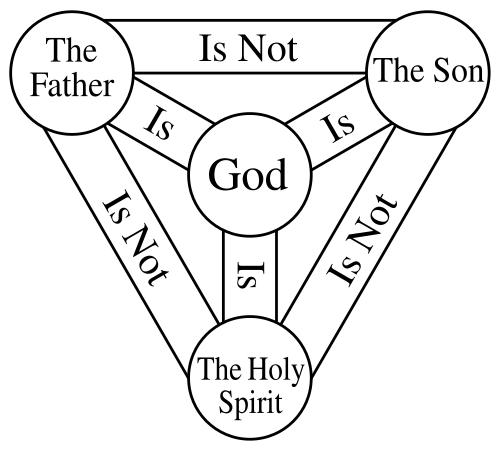
There is a joke among preachers that Trinity Sunday is the one day a year we are most likely to commit heresy from the pulpit. It is funnier than it should be, because it is true. Stand a pastor in front of a congregation, ask him to explain how God is one and also three, and within ninety seconds he will have said something the early church spent four centuries condemning.
The temptation is the analogy. We reach for something familiar to make the strange thing simple. Water, we say, can be ice, liquid, and steam — three forms, one substance. There: the Trinity, explained. Except it isn't. It is a heresy with a name.
The water analogy describes modalism — the idea that Father, Son, and Spirit are not three eternal Persons but three modes the one God moves through, like an actor changing costumes between scenes. Ice melts into water and boils into steam; it is never all three at once. But the God of Scripture is not a single actor playing three parts in sequence. At the Jordan, the Son stands in the water, the Spirit descends as a dove, and the Father speaks from heaven — three Persons, present together, in one moment. Modalism cannot hold that scene. So the church rejected it. The analogy we reached for to make God simple ended up making God smaller than he is.
This is the trap. Every well-meaning attempt to explain the Trinity tends to collapse into one heresy or another. The diagram the medieval church drew to guard against this — the Shield of the Trinity — does not explain anything at all. It only fences off the errors: the Father is not the Son, the Son is not the Spirit, the Spirit is not the Father — and each one is God. It is not a solution. It is a boundary marker, telling us where the cliff edges are. That alone should tell us something about what we are dealing with.
Augustine said it in four Latin words: Si comprehendis, non est Deus. "If you can comprehend it, it isn't God." That is not a failure of theology. It is theology arriving at the truth about its own subject. A God you could fit inside your understanding would be a God roughly the size of your understanding — which is to say, no God at all.
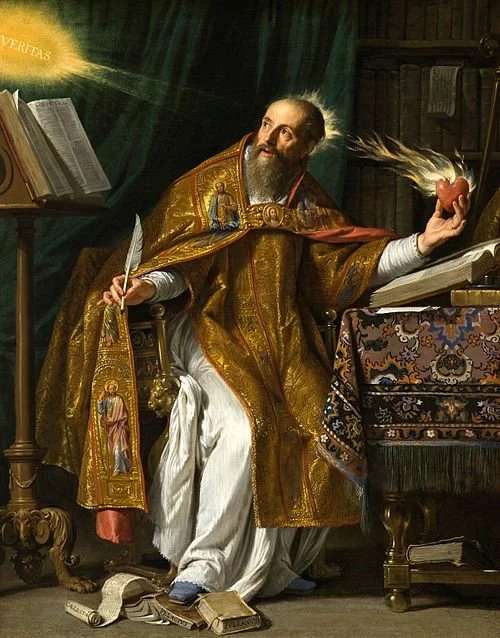
Saint Augustin by Philippe de Champaigne, c. 1645
We do not love this. We are people who solve things. We want the dry-erase board and enough markers to diagram our way to the bottom of it.
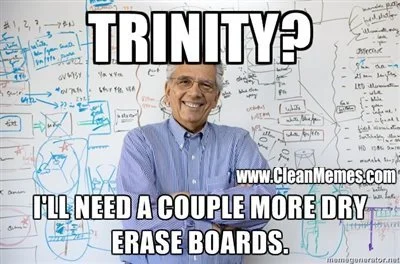
The annual pastoral temptation
But some things are not problems to be solved. They are realities to be entered. And the deepest of them — God himself — will always exceed the reach of the mind that bends toward him. Gregory of Nazianzus, who helped the church find the very language we use for the Trinity, described the experience from the inside: "No sooner do I conceive of the One than I am illumined by the splendor of the Three; no sooner do I distinguish the Three than I am carried back to the One." That is not confusion. That is what it feels like to stand at the edge of something true and too large. The mind reaches, grasps, and is gently handed back what it cannot hold.
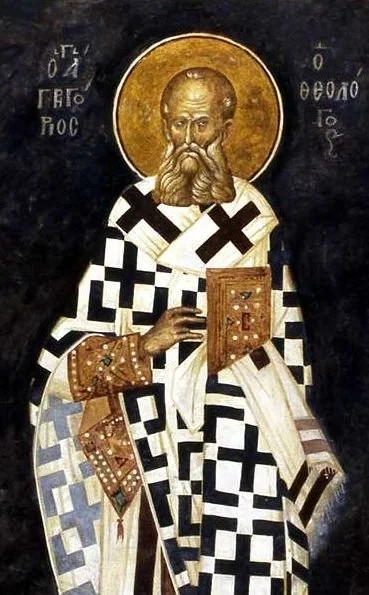
Gregory of Nazianzus, Fresco from The Chora, 14th cent.
Even his name resists us. Gregory of Nazianzus — say it three times and you will feel, in miniature, the same thing the doctrine does to the mind: it slips, it doubles back, it will not sit still on the tongue. The difficulty is not a flaw in him or in the doctrine he defended. It is the appropriate friction of approaching something that does not reduce.
And here is where the gospel turns the whole problem on its head. Because inscrutable does not mean inaccessible. The God you cannot diagram is not the God who keeps his distance.
Consider the eleven on the mountain in Galilee — the first people ever asked to face the Trinity directly. Matthew tells us they worshiped him. And then, in the same breath, he tells us something startling: but some doubted. Not after. Not later. In the same moment that they fell down in worship, some of them were of two minds. Worship and wavering, occupying the same heart, at the same time.
Notice what Jesus does with that. He does not wait for the doubt to clear. He does not quiz them. He does not pull out a marker and explain. He simply says, "All authority in heaven and on earth has been given to me" — and on the strength of that, not the strength of their certainty, he sends them. He commissions waverers. He always has.
And then the last word — the word the entire Gospel of Matthew has been bending toward from its opening pages. The book began with a name: Emmanuel, God with us. It ends with a promise in the same key: "I am with you always, to the very end of the age."
That is the answer to the puzzle we could not solve. Not an explanation. A presence. We do not get a God reduced to something we can hold in our hands. We get a God who holds us. We do not get comprehension. We get company — and company that does not leave.
So when it comes to the Trinity, let the analogies go. Let the dry-erase boards stay in the closet. You were never going to fit God on them anyway. The mystery you cannot explain is not a wall between you and God. It is the size of the One who is, even now, with you.